
Instruments specifically formulated for feldspathic porcelain and layered ceramic restorations. Gentle, controlled abrasion preserves surface integrity and prevents micro-fractures in delicate fired ceramic — delivering precise adjustment without compromising the restoration.
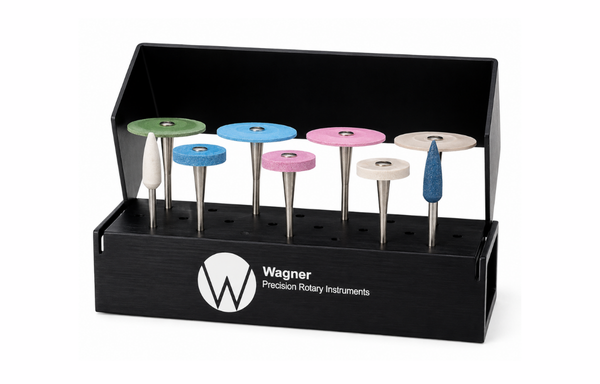
Feldspathic porcelain and layered ceramic restorations present a unique challenge: the material is aesthetically superior but mechanically sensitive. Conventional abrasives designed for zirconia or metal apply excessive force that can initiate sub-surface micro-fractures in the glassy feldspathic matrix. Wagner Precision Feldspathic Ceramic Instruments use a low-pressure abrasive system — diamond and silicon carbide formats — calibrated specifically for the hardness range of fired feldspathic porcelain.
| Parameter | Specification |
|---|---|
| Compatible Materials | Feldspathic porcelain, layered ceramic, leucite-reinforced ceramic |
| Abrasive Types | Diamond, Silicon Carbide (SiC) |
| Technique | Light pressure; water coolant recommended for diamond formats |
| Recommended Speed | 10,000–15,000 RPM |
| Application | Fired ceramic restorations — chairside and laboratory |
Two abrasive chemistries for different stages of the feldspathic finishing workflow.
Feldspathic porcelain is among the most technique-sensitive dental materials. These instrument recommendations reflect best practice for chairside and laboratory ceramic adjustment.
Always use water coolant when adjusting fired feldspathic ceramic. Thermal shock from dry grinding can propagate micro-fractures that are invisible at adjustment but cause clinical failure later.
Remove only the material necessary for fit and occlusion. Excessive reduction weakens the ceramic cross-section and increases fracture risk in the medium term.
After chairside adjustment, either re-fire the restoration with a glaze cycle or polish the adjusted area with SiC instruments to restore surface smoothness and stain resistance.
Use light, sweeping strokes rather than sustained heavy pressure. This protects both the ceramic surface and the instrument, extending usable life and improving cutting control.