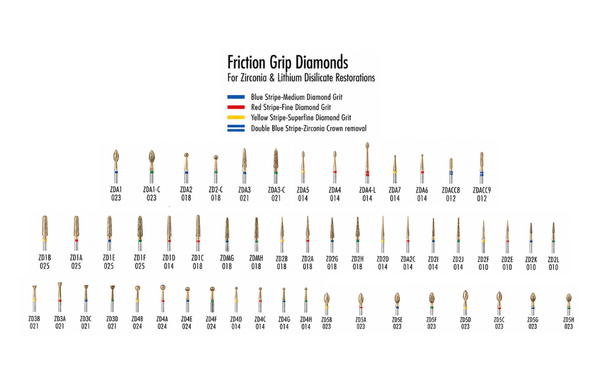
Complete instrument guide for working with fully sintered zirconia and sintered lithium disilicate restorations. Recommended sequences, compatible instruments, and clinical protocols for predictable, high-quality outcomes.
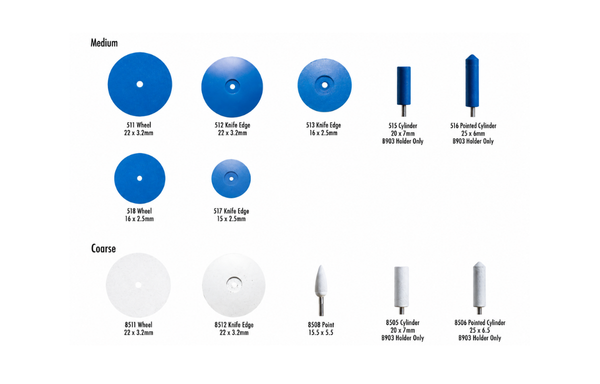
Fully sintered zirconia and sintered lithium disilicate represent two of the most demanding restorative materials in modern dentistry. Each presents distinct clinical challenges during adjustment and finishing:
After firing, zirconia achieves a Vickers hardness of approximately 1,200 HV — harder than conventional porcelain by a factor of three. Standard finishing instruments dull within seconds on sintered zirconia, generating frictional heat that induces monoclinic phase transformation and weakens the restoration surface. Wagner Precision instruments for sintered zirconia use high-concentration diamond bonds engineered to maintain cutting efficiency across the full hardness range of 3Y through 5Y zirconia.
IPS e.max and similar lithium disilicate materials are fired to approximately 500–850 HV — significantly softer than sintered zirconia, but brittle and crack-prone under excessive pressure or thermal shock. Finishing instruments for lithium disilicate must cut efficiently without generating the heat or vibration that initiates sub-surface radial cracking.
This five-step sequence guides the clinician or laboratory technician through the complete finishing workflow for sintered zirconia and sintered lithium disilicate restorations.
Articulating paper (8–12 micron) identifies premature contacts. Use a coarse ZrHP Diamond (coarse, red) or Diacool Ice (coarse) to reduce identified high points. Work with continuous water coolant at 150,000–200,000 RPM.
Instruments: ZrHP Diamonds (Coarse) or Diacool Ice (Coarse)
Switch to a medium grit to refine the restoration’s anatomical form — cusp morphology, embrasure form, and axial profile. Address any remaining milling lines or surface irregularities from the CAD/CAM process.
Instruments: ZrHP Diamonds (Medium) or Diacool Ice (Medium/Blue)
Progress through fine (yellow) and extra-fine (white) instruments in sequence. Each step must completely obliterate the scratch pattern of the previous grit before advancing. Inspect under magnification if available.
Instruments: Diacool Ice (Fine & Extra Fine) or ZrHP Diamonds (Fine/White)
Apply the super-fine (light blue) diamond to create a near-gloss surface uniformly across all restoration surfaces. The surface should appear uniformly hazy with no visible directional scratches before proceeding to polishing.
Instruments: Diacool Ice (Super Fine / Light Blue) or ZrHP Diamonds (Super Fine)
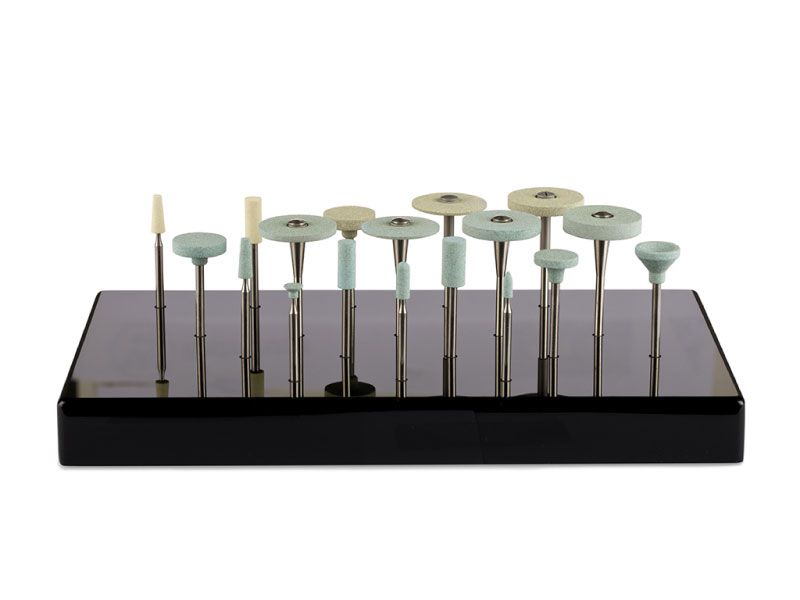
Apply zirconia polishing points and cups to achieve the final high-gloss surface. For zirconia, the Panther polishing system develops a mirror-like finish that matches natural enamel reflectivity. Polishing paste is not required when using instrument-embedded abrasive systems.
Instruments: Panther Polishing System, ZrHP Diamond Kit polishing points
Each instrument in the recommended sequence is available individually or as part of the complete ZrHP Diamond Kit.
FG-shank diamond instruments with coolant-optimized geometry. ISO color-coded grit system.
View Product →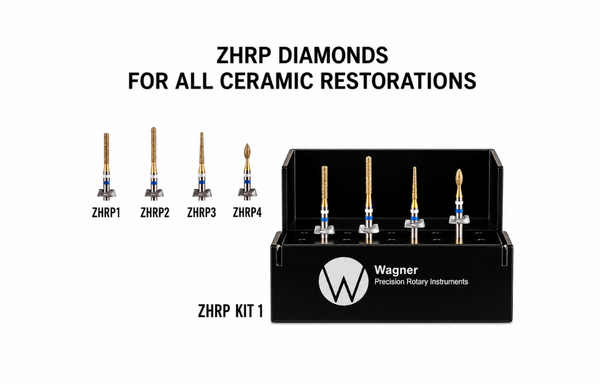
HP-shank diamonds for chairside and laboratory adjustment of sintered ceramics.
View Product →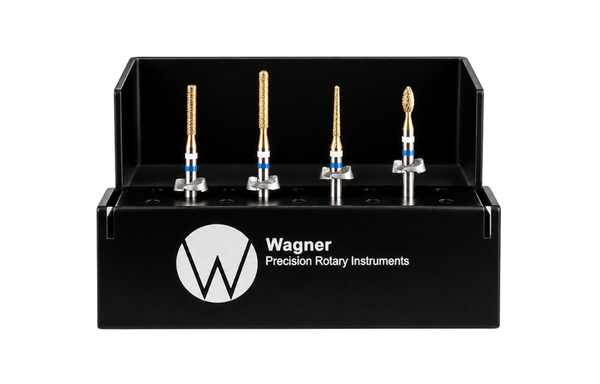
Complete all-in-one kit — all instruments for steps 1–5, organized for immediate use.
View Kit →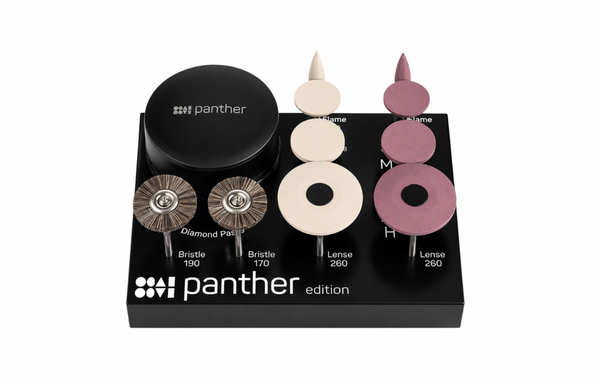
The flagship polishing system. Advanced composite delivers glass-like finishes on all ceramic materials.
View Product →