Wagner Precision’s complete overview of instruments for zirconia and lithium disilicate dental restorations. Learn about material challenges, clinical demands, and how Wagner instruments are engineered to solve them.
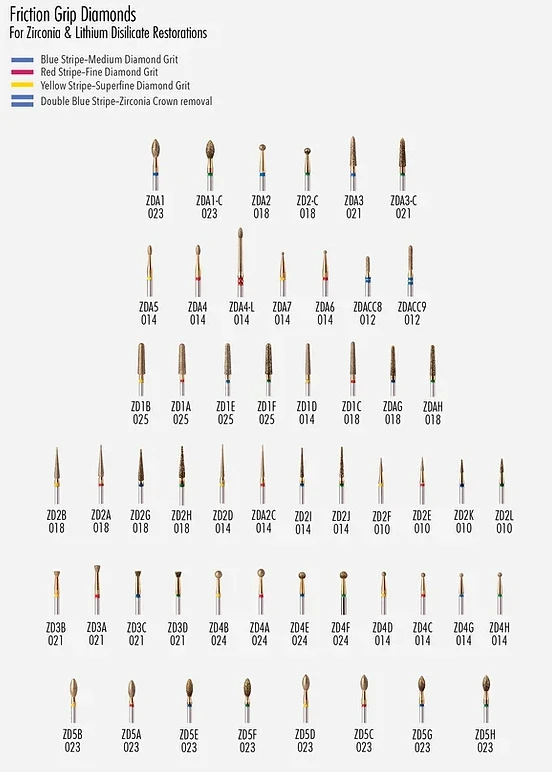
Zirconia and lithium disilicate now account for the majority of fixed restorations placed worldwide. Their combination of mechanical strength, biocompatibility, and esthetic quality has displaced PFM and conventional porcelain in most clinical indications. But working with these materials effectively requires instruments engineered specifically for their properties — not adapted from general-purpose bur lines.
Both zirconia and lithium disilicate share a critical characteristic: they are hard enough to resist conventional finishing instruments, and brittle enough to fracture catastrophically if subjected to excessive heat, vibration, or stress concentration during adjustment.
Conventional carbide burs and standard porcelain finishing instruments were not engineered for post-sinter ceramic hardness. Using them on zirconia or lithium disilicate generates excessive frictional heat, causes rapid instrument wear, and introduces sub-surface micro-cracks that may not be visible at delivery but manifest as early restoration failure.
Wagner Precision’s zirconia and lithium disilicate instrument lines address these challenges directly — with diamond bond concentrations, cutting geometries, and grit progressions calibrated to the specific hardness and fracture toughness of each material.
| Property | Zirconia (sintered) | Li-Di (e.max) |
|---|---|---|
| Vickers Hardness | ~1,200 HV | ~560–600 HV |
| Flexural Strength | 900–1,400 MPa | 360–530 MPa |
| Translucency | Low–High (3Y–5Y) | High |
| Primary Use | Posterior, bridges, implants | Anterior & posterior single units |
Both materials exist in multiple clinical states that require different instrument strategies. Understanding these states is the foundation of an effective finishing protocol.
Freshly milled or manually shaped zirconia before furnace firing. The porous, chalk-like matrix is workable with standard abrasives but requires instruments with a controlled grit release to prevent chipping and micro-fracture. This is the easiest — and most efficient — stage at which to adjust form and contour.
Recommended Instruments: Green State Instruments
After sintering at 1,450–1,530°C, zirconia reaches its full ~1,200 HV hardness and approximately 20% linear shrinkage. Only high-concentration diamond instruments maintain adequate cutting efficiency. Heat management is critical — monoclinic phase transformation under thermal stress reduces surface strength.
Recommended Instruments: Diacool Ice, ZrHP Diamonds, ZrHP Diamond Kit
IPS e.max CAD in its blue, partially crystallized state is significantly softer than the final fired material. This state is optimal for CAD/CAM machining and can be adjusted with medium-grit diamonds before crystallization firing. Fine instruments are used to smooth milling marks before the final glaze/crystallization cycle.
Recommended Instruments: Diacool Ice (Medium/Fine), ZrHP Diamonds
After crystallization firing or heat pressing, lithium disilicate reaches approximately 560–600 HV and a flexural strength of 360–530 MPa. At this stage, adjustments must use fine diamond instruments with coolant to prevent thermal shock and radial crack initiation.
Recommended Instruments: Diacool Ice (Fine through Super Fine), ZrHP Diamond Kit
The most common problems clinicians and laboratory technicians encounter when finishing zirconia and lithium disilicate share a root cause: instruments not engineered for post-sinter hardness.
Standard diamonds dull within a single case on sintered zirconia, requiring multiple instrument changes and generating cost-per-use rates that exceed premium dedicated instruments.
Wagner Solution: High-concentration diamond bond in ZrHP and Diacool Ice maintains cutting efficiency across the full hardness range.
Frictional heat above ~200°C causes monoclinic phase transformation in zirconia and thermal cracking in lithium disilicate. Surface damage may not be visible immediately but dramatically reduces long-term restoration survival.
Wagner Solution: Diacool Ice coolant-channel geometry and continuous water spray protocols keep the cutting zone below critical thresholds.
Mixing instruments from incompatible systems creates grit progression gaps. Skip a step and the next instrument cannot remove the residual scratch pattern, producing a surface that polishes unevenly and reflects light inconsistently.
Wagner Solution: The ZrHP Diamond Kit provides a calibrated five-step sequence with no progression gaps — consistent results every case.
Inappropriate abrasives in the green state compress the porous matrix, creating stress concentrations that propagate into full-thickness cracks during sintering — producing restorations that fail before delivery.
Wagner Solution: Green State Instruments use a controlled-release abrasive bond that removes material progressively without compressing the porous matrix.
Select the stage of your workflow to find the right Wagner Precision instruments.
Instruments for shaping pre-sintered zirconia blanks before furnace firing.
Green State Instruments → SinteredComplete five-step instrument sequence for sintered zirconia and lithium disilicate.
Sintered Ceramics Guide → DiamondFG-shank ultra-fine diamond instruments with coolant-channel cutting geometry.
View Diacool Ice → Complete KitThe all-in-one kit — every instrument for every step, calibrated for consistent results.
View ZrHP Kit → HP ShankHP-shank diamonds for chairside and laboratory adjustment. Multiple grits available.
View ZrHP Diamonds → Browse AllSee every Wagner Precision instrument compatible with zirconia and lithium disilicate.
Browse All →Every Wagner Precision instrument for zirconia and lithium disilicate is manufactured in New Jersey and has been developed over decades of direct collaboration with dental laboratories and clinicians.